Assessment tools for recruitment and selection
- Candidate A, weighted score out of 10
- 7.6
- Computed on this page from the inputs below
- Your weights add up to (should be 100)
- 100
- Computed on this page from the inputs below
- Candidate B, weighted score out of 10
- 7.3
- Computed on this page from the inputs below
- The gap between them
- 0.3
- Computed on this page from the inputs below
The numbers on this page come from the inputs you enter and the method stated: 3,600 seconds to an hour, 52 weeks to a year, twelve months to a year, and nothing else. No industry shrinkage figure, no occupancy benchmark and no assumption about your attrition; every one of those is yours to enter.
Email me this result
We will send you these figures and a link back to them. One email, nothing else unless you tick the box.
The figures above start from a worked example (7.6). Change any input and the answer updates as you type.
Download the Assessment tools for recruitment and selection worked example (CSV)
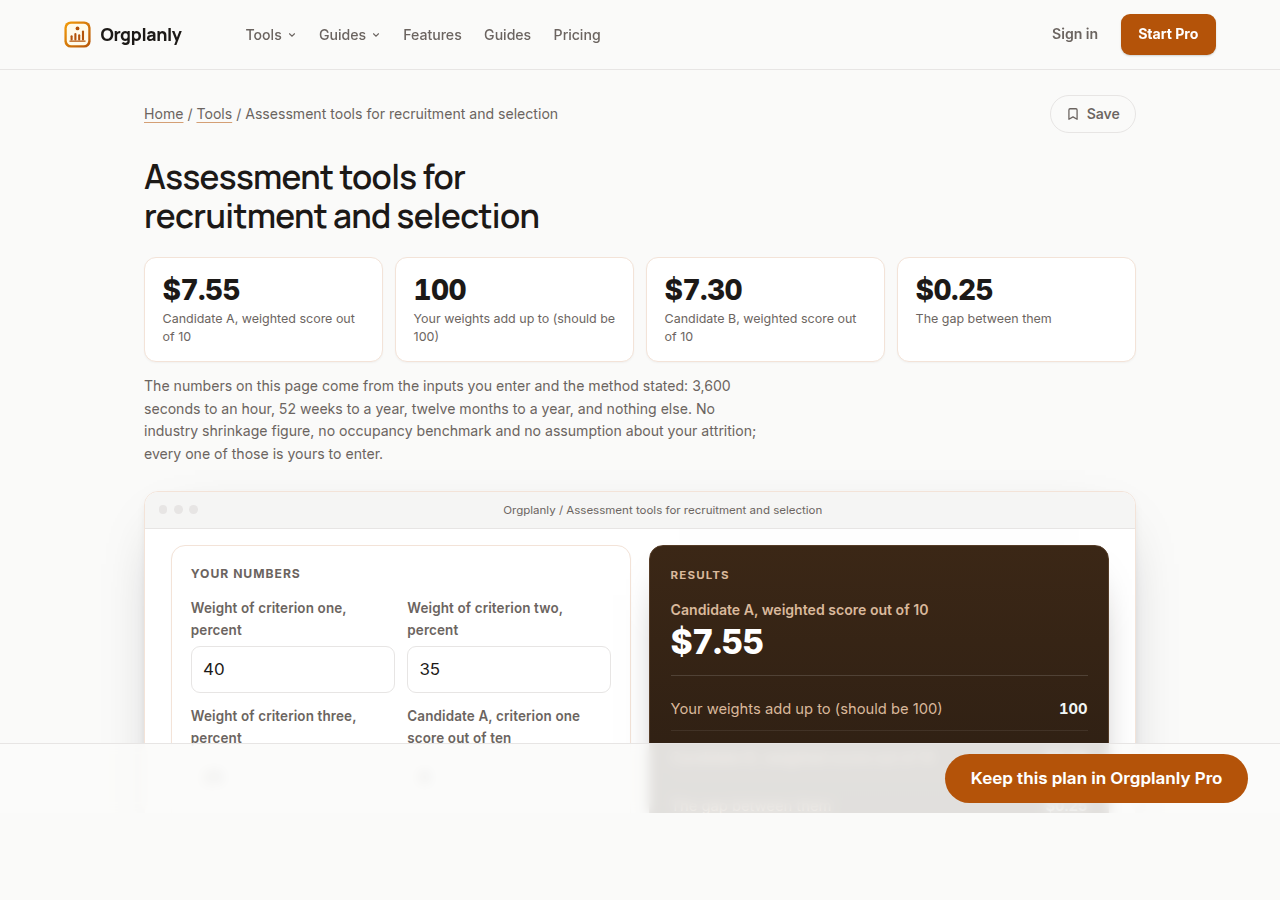
Assessment tools for recruitment and selection are usually sold as instruments; this sheet is the arithmetic underneath one. Enter the weight of each of three criteria and each candidate's raw score out of ten, and it returns the weighted score per candidate, the gap between them, and what the same scores say unweighted. On the worked example the weights are 40, 35 and 25, candidate A scores 8, 6 and 9 while candidate B scores 6, 9 and 7: A comes out at 7.55 against B's 7.30, so A leads. Unweighted, they read 7.67 and 7.33, which is the same order but a different margin. When the weighting changes the ORDER rather than the margin, that is the moment to check the weights are what the hiring manager actually believes, because the ranking is being produced by the weights and not by the candidates.
The weights are the decision
Scores feel like the substance and the weights feel like bookkeeping, but the weights are where the judgement lives. Deciding that criterion one is worth 40% and not 25% is a hiring decision made before anyone is interviewed, which is exactly when it should be made.
Always look at the unweighted pair
The sheet returns both so you can see whether your weighting is doing real work or just adding decimals. If weighted and unweighted disagree about the winner, the weights deserve a conversation.
A small gap is a real result
0.25 between two candidates on a ten-point scale is not a mandate. The sheet shows the gap rather than only the ranking, because a near-tie should be settled by something other than arithmetic.
Assessment tools for recruitment and selection: common questions
Do my weights have to add to 100? No. The sheet divides by whatever they sum to, so 4, 3 and 3 works as well as 40, 35 and 25. It returns the total so you can see what you actually entered.
Is a scored matrix legally safer than a conversation? That is a question for your employment lawyer and this site publishes no rule about it. A consistent, written, job-related scoring method is generally easier to explain than a memory, but the sheet is arithmetic, not compliance.
Only three criteria? Three is enough to show whether the weighting changes the order, which is the point. If you score against seven, run the three that carry most of the weight and check the ranking against your full sheet.
Orgplanly Pro
Keeping what you make
The worksheet answered today's question. Pro keeps the answer: the plan you just worked saved against the team it belongs to, re-opened at the next review instead of rebuilt, branded and exported for the budget meeting.
- Download the finished checklist or intake form as a file the client accepts
- The paperwork goes out clean, without the Kickoffo watermark
- Re-use the checklist for the next client instead of rebuilding it
- Your firm's logo on every checklist and form you send
- Export every client's onboarding at once when the account review or the buyer asks
- Send the plan for review from the record, not a spreadsheet
- Not part of Orgplanly today; your billing stays where it is
- Not part of Orgplanly today; your ledger stays where it is
$90per month, whole team
Start Orgplanly Pro Free for 14 days. No card needed. PricingThe first 14 days are free and no card is asked for. Add a card during the trial and the first charge is on the day it ends; do not, and your workspace becomes read-only with nothing deleted. Orgplanly Pro renews monthly at $6.50 per user per month until you cancel; the price and renewal terms are shown before checkout.
Where the constants in this tool come from
US Bureau of Labor Statistics: Job Openings and Labor Turnover Survey.