How much are benefits worth
- Benefits cost per employee a year
- $11,900
- Computed on this page from the inputs below
- Per employee a month
- $991.67
- Computed on this page from the inputs below
- As a percent of base salary
- 19.2
- Computed on this page from the inputs below
- Salary plus benefits, per employee
- $73,900
- Computed on this page from the inputs below
The numbers on this page come from the inputs you enter and the method stated: 3,600 seconds to an hour, 52 weeks to a year, twelve months to a year, and nothing else. No industry shrinkage figure, no occupancy benchmark and no assumption about your attrition; every one of those is yours to enter.
Email me this result
We will send you these figures and a link back to them. One email, nothing else unless you tick the box.
The figures above start from a worked example ($11,900). Change any input and the answer updates as you type.
Download the How much are benefits worth worked example (CSV)
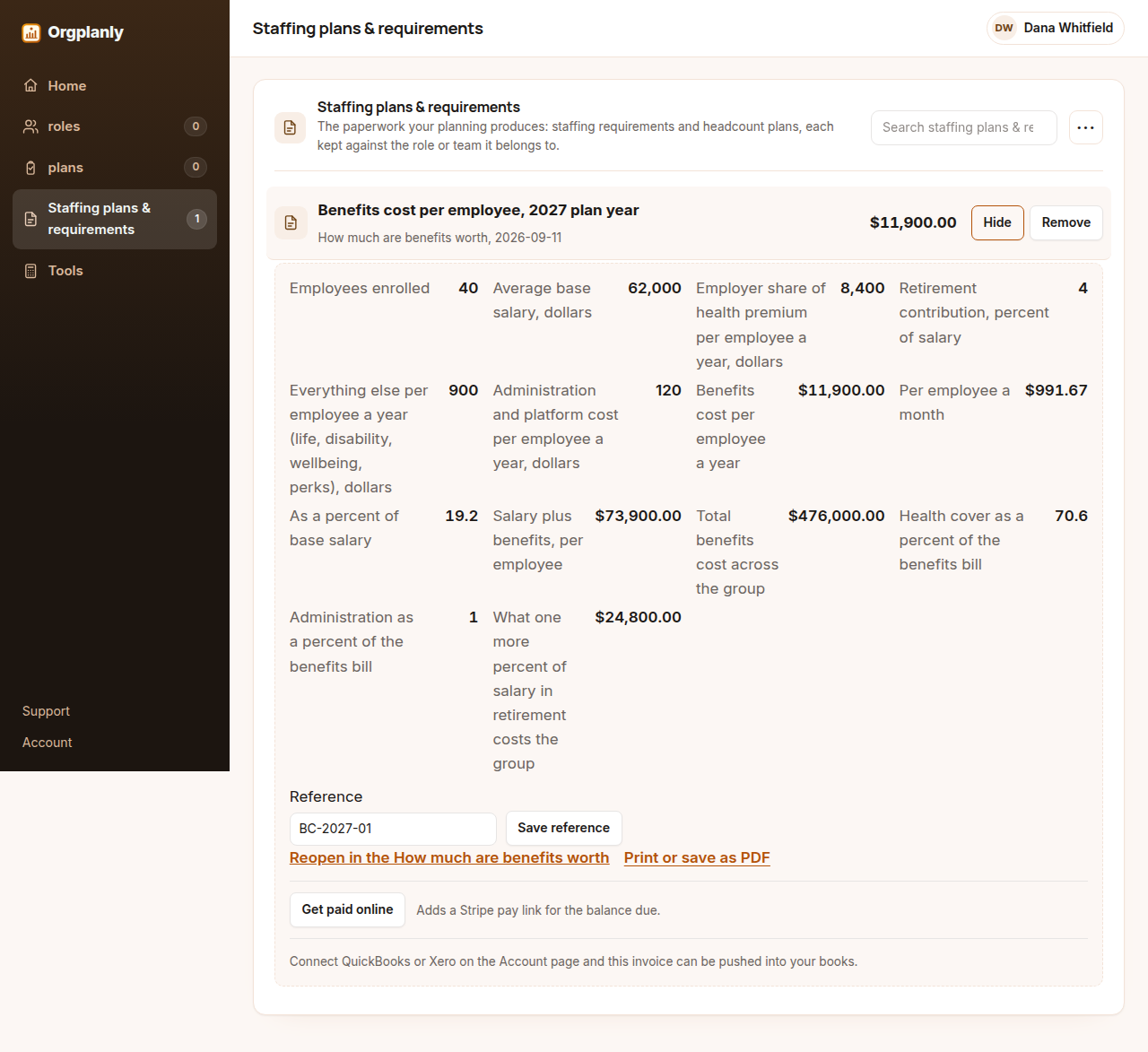
The how much are benefits worth worksheet answers the question an HR or finance partner is asked every autumn and can rarely answer on the spot: what does the package cost per employee, and what is it as a share of pay. It takes the employer's own six numbers, the headcount enrolled, average base salary, the employer share of health premium, the retirement contribution rate, everything else per head and the administration cost, and returns the cost per employee a year and a month, the same figure as a percent of salary, the fully loaded cost of an employee, the total across the group, and the share of the bill that health cover and administration each take. It also prices one decision directly: what one more percent of salary in retirement contribution costs the whole group. Enter your own figures and it computes on the page, with no account.
Per employee first, because that is the number people argue about
Everything here is built on one sum: employer health premium share, plus salary times the contribution rate, plus the per-head cost of everything else, plus administration. That is the cost per employee a year, and dividing by twelve gives the figure a budget holder recognizes. It is deliberately not an average from a survey, because a survey figure cannot be defended in a room where somebody knows what your renewal was.
As a share of salary, because that is how it is benchmarked
Expressing the same total as a percent of base salary is what makes it comparable year to year and across roles, and it is how the figure will be quoted back at you. Watch it rather than the absolute number: a benefits bill that grows with the payroll is doing what it should, and one whose share of salary climbs is telling you the renewal or the package changed, which are two very different conversations.
Where the money actually is
The health and administration shares are printed because they are almost always misjudged in opposite directions. Employer health premium is usually the large majority of the bill, which means the renewal decides the line and the perks do not; administration is usually a low single-digit share, which means cutting it saves little and is rarely where the savings are. Knowing both stops a benefits review spending its effort on the wrong line.
The price of one more point
The last output takes the retirement contribution rate up by one percentage point and prices it across the whole group, because that is the form the decision actually arrives in. It is a clean number, salary times headcount divided by a hundred, and having it on the page turns a question that usually gets deferred into one that can be answered in the meeting.
How much are benefits worth: common questions
Should the employer share or the total premium go in? The employer share, because that is what the plan pays. The employee's payroll deduction is their cost, not the plan's, and mixing the two inflates the figure by roughly a quarter on a typical arrangement.
What belongs in everything else per head? Group life, disability cover, the employee assistance program, wellbeing, and whatever perks are actually paid for. Keep anything the employer does not pay for out of it, however prominent it is on the benefits page.
Where do the numbers come from? Entirely from your six inputs. No industry average, no benchmark and no assumed premium appears in the arithmetic, which is why the worked example is the only example on the page.
Why is administration shown separately? Because it is the only line an employer can change without changing the package, and because it is usually much smaller than people expect. Seeing it as a share of the bill settles the question of whether a platform switch is worth the disruption.
Orgplanly Pro
Keeping what you make
The worksheet answered today's question. Pro keeps the answer: the plan you just worked saved against the team it belongs to, re-opened at the next review instead of rebuilt, branded and exported for the budget meeting.
- Keep this scenario, so next quarter starts from it instead of a blank sheet
- Put two scenarios side by side: the plan at your attrition and the plan at last year's
- The plan goes out clean, without the Orgplanly watermark
- Send the plan for review from the record, not a spreadsheet
- Not part of Orgplanly today; your billing stays where it is
- Not part of Orgplanly today; your ledger stays where it is
$90per month, whole team
Start Orgplanly Pro Free for 14 days. No card needed. PricingThe first 14 days are free and no card is asked for. Add a card during the trial and the first charge is on the day it ends; do not, and your workspace becomes read-only with nothing deleted. Orgplanly Pro renews monthly at $6.50 per user per month until you cancel; the price and renewal terms are shown before checkout.