Best ATS for staffing agencies
- The agency fee on one role
- $18,000
- Computed on this page from the inputs below
- Difference against filling it yourself
- $14,800
- Computed on this page from the inputs below
- A year of hiring at agency rates
- $108,000
- Computed on this page from the inputs below
- A year of hiring in-house, plus a recruiter
- $104,200
- Computed on this page from the inputs below
The numbers on this page come from the inputs you enter and the method stated: 3,600 seconds to an hour, 52 weeks to a year, twelve months to a year, and nothing else. No industry shrinkage figure, no occupancy benchmark and no assumption about your attrition; every one of those is yours to enter.
Email me this result
We will send you these figures and a link back to them. One email, nothing else unless you tick the box.
The figures above start from a worked example ($18,000). Change any input and the answer updates as you type.
Download the Best ATS for staffing agencies worked example (CSV)
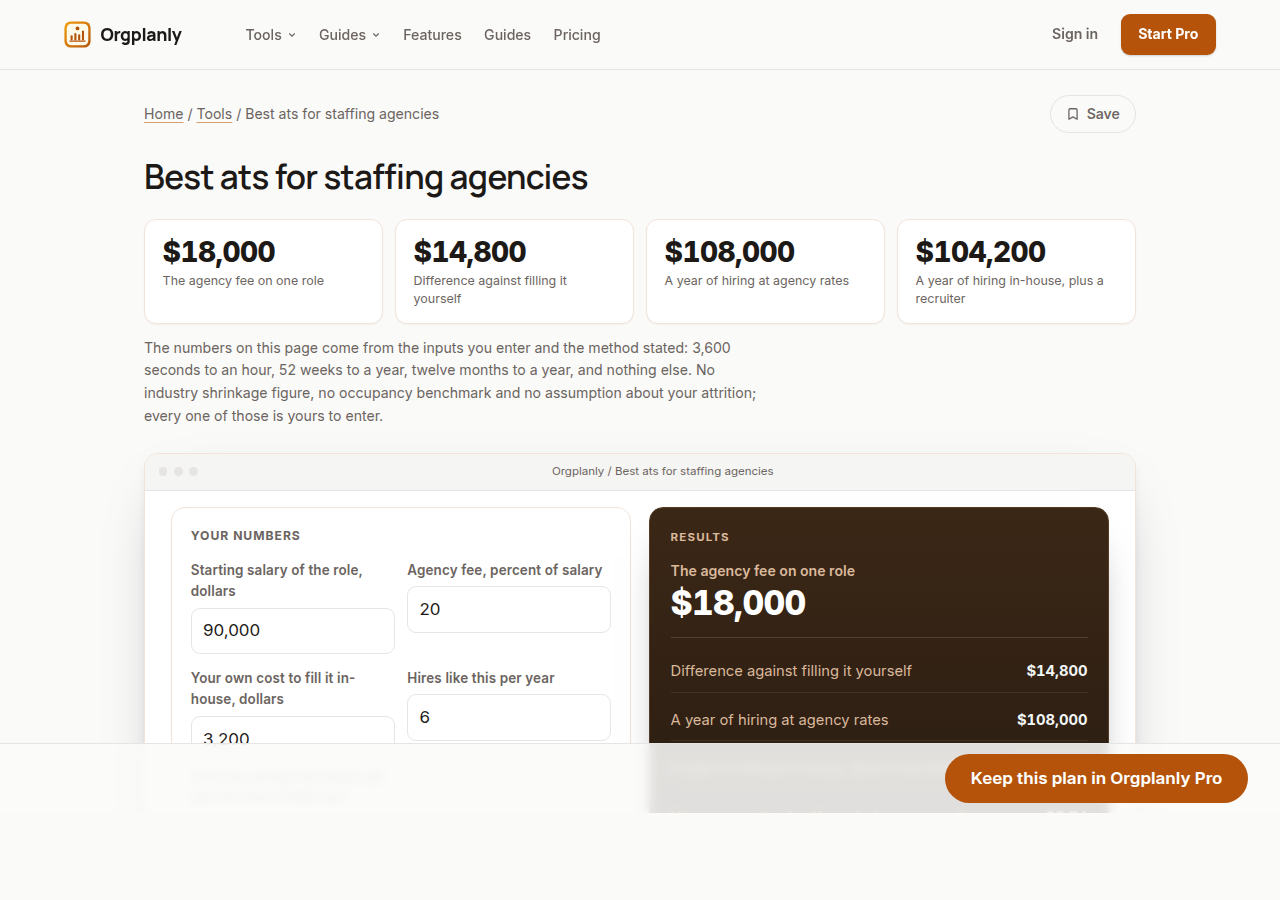
The best ATS for a staffing agency is a different purchase from the best ATS for the company paying that agency, and this sheet is for the second one deciding whether to keep paying. Enter the starting salary, the agency's fee percentage, what it costs you to fill the same role in-house, the hires like this you make in a year, and what an in-house recruiter would cost. It returns the fee on one role, the difference against doing it yourself, a year of hiring each way, and the number of hires a year at which the recruiter pays for themselves. On the worked example, a $90,000 role at 20% is an $18,000 fee against $3,200 to fill it yourself: $14,800 of difference per role, and at $85,000 for a recruiter the break-even is 5.7 hires a year. Six hires a year makes the recruiter the cheaper option by $3,800; five makes the agency cheaper. That is the whole decision, and it is arithmetic.
The in-house number has to be honest
Take it from the cost per hire sheet on this site, with your own hours in it. Comparing a real agency invoice against an in-house cost that pretends recruiting is free produces an answer that is always the same and always wrong.
Break-even is a range, not a line
5.7 hires on the worked example. Below it the agency wins, above it the recruiter does, and near it the decision turns on things this sheet cannot weigh: how lumpy the hiring is, and whether you can keep a recruiter busy in a quiet quarter.
Agencies are not all or nothing
The most common honest answer is a recruiter for the roles you hire repeatedly and an agency for the rare and senior ones. Run the sheet twice, once per group, rather than once for everything.
Best ATS for staffing agencies: common questions
Is 20% the normal fee? Contingency fees commonly sit somewhere between 15% and 25% of first-year salary, and executive search is usually higher and retained. This site publishes no benchmark: put in the number your agency actually charges you.
Should the rebate period change the maths? It changes the risk rather than the price, and the contingency agreement sheet on this site works that side: what share of a fee is at risk through a rebate window.
What about the quality difference? The sheet does not model it and will not pretend to. It gives you the money, so the quality argument can be had on its own terms rather than as a proxy for a cost nobody has calculated.
Orgplanly Pro
Keeping what you make
The worksheet answered today's question. Pro keeps the answer: the plan you just worked saved against the team it belongs to, re-opened at the next review instead of rebuilt, branded and exported for the budget meeting.
- Download the finished checklist or intake form as a file the client accepts
- The paperwork goes out clean, without the Kickoffo watermark
- Re-use the checklist for the next client instead of rebuilding it
- Your firm's logo on every checklist and form you send
- Export every client's onboarding at once when the account review or the buyer asks
- Send the plan for review from the record, not a spreadsheet
- Not part of Orgplanly today; your billing stays where it is
- Not part of Orgplanly today; your ledger stays where it is
$90per month, whole team
Start Orgplanly Pro Free for 14 days. No card needed. PricingThe first 14 days are free and no card is asked for. Add a card during the trial and the first charge is on the day it ends; do not, and your workspace becomes read-only with nothing deleted. Orgplanly Pro renews monthly at $6.50 per user per month until you cancel; the price and renewal terms are shown before checkout.
Where the constants in this tool come from
US Bureau of Labor Statistics: Job Openings and Labor Turnover Survey.